Charting Neural Upscaling Pipelines for Legacy Film Restoration in Enthusiast Hardware Clusters
Mara Hughes · Jun 1, 2026
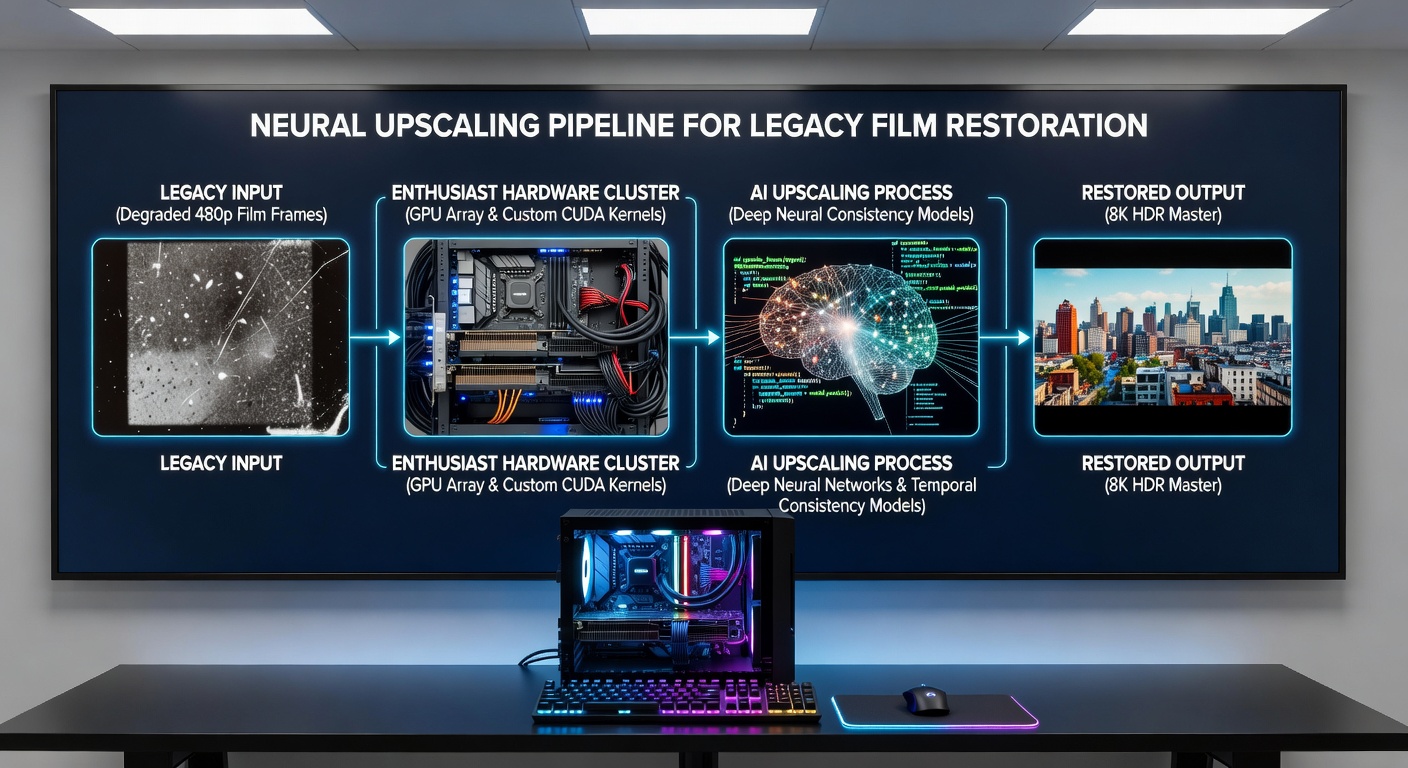
Charting Neural Upscaling Pipelines for Legacy Film Restoration in Enthusiast Hardware Clusters
Neural upscaling pipelines have become central to restoring legacy films because they apply machine learning models to enhance resolution and detail in older footage while preserving original artistic intent. Enthusiast hardware clusters combine consumer-grade GPUs and CPUs to run these pipelines at scale without relying on enterprise data centers and researchers have documented steady growth in such setups since the early 2020s.
Core Components of Neural Upscaling Pipelines
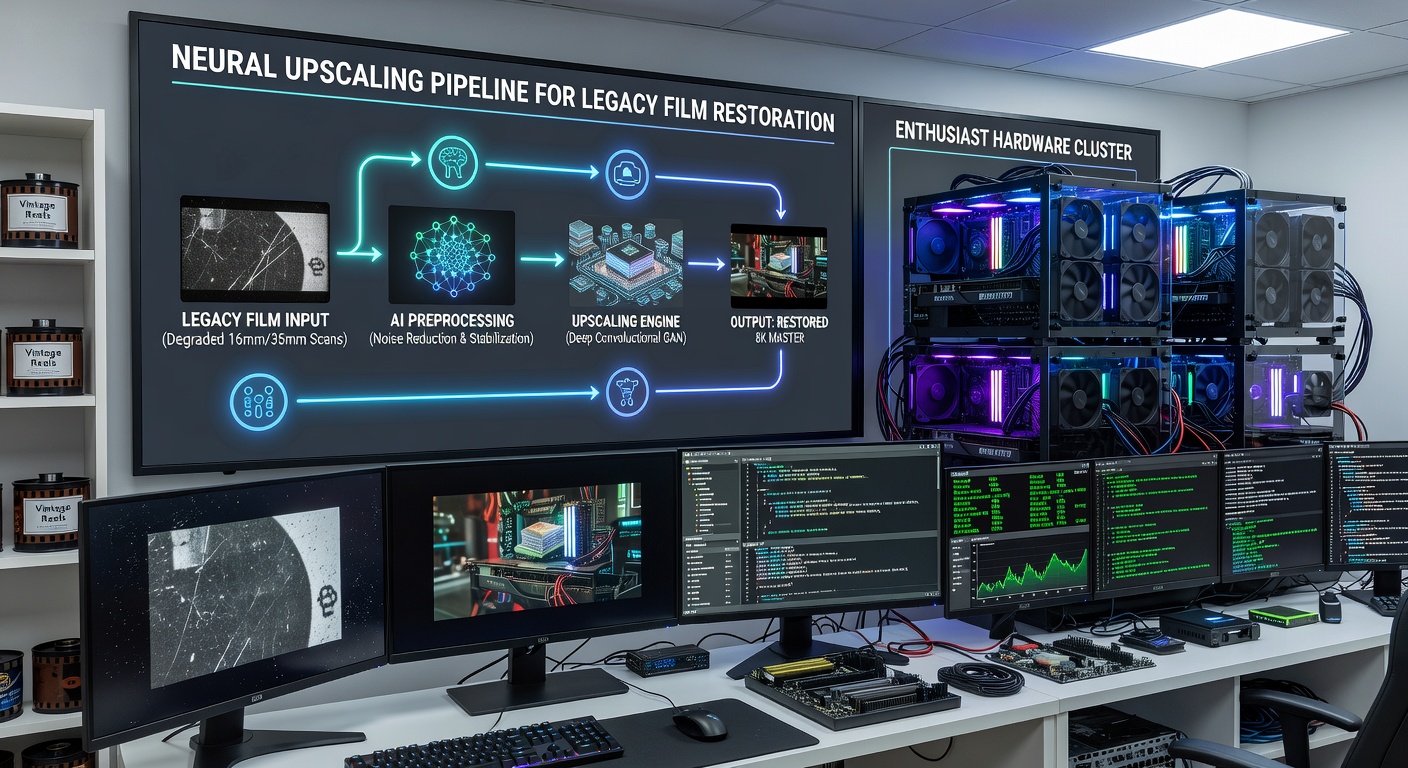
These pipelines typically begin with frame extraction and preprocessing steps that align temporal information across sequences before feeding data into convolutional or transformer-based networks trained on paired low-resolution and high-resolution examples. Models such as ESRGAN variants or newer diffusion-based architectures then generate missing pixels while motion compensation algorithms reduce artifacts during upscaling and post-processing stages apply denoising filters along with color correction to match archival standards. Observers note that integration of temporal consistency checks across frames improves output quality significantly when compared to frame-by-frame methods alone.
Pipeline orchestration often relies on open-source frameworks like TensorFlow or PyTorch distributed across cluster nodes where task schedulers assign frame batches to available GPUs and results merge through shared storage systems. Data indicates that such distributed approaches reduce processing time for a two-hour film from weeks on single machines to days when multiple nodes operate in parallel.
Building and Managing Enthusiast Hardware Clusters
Enthusiast clusters usually consist of multiple desktop systems linked via high-speed Ethernet or InfiniBand with each node featuring several consumer GPUs such as RTX 40-series cards and sufficient RAM to hold model weights during inference. Cluster management software coordinates job distribution and monitors temperature along with power draw to maintain stability during extended runs and community forums report configurations ranging from four to sixteen nodes for hobbyist film restoration projects.
Power efficiency becomes a key consideration because sustained neural inference loads generate substantial heat and electricity costs while software tools optimize batch sizes and precision levels to balance speed against quality. Studies from academic institutions show that mixed-precision training and inference techniques cut resource demands without measurable loss in visual fidelity for many film types.
Recent Developments and June 2026 Milestones
What's interesting is how open-source model releases have accelerated adoption among independent restorers and in June 2026 several updated neural architectures tailored for 35mm and 16mm film grain patterns became available through public repositories. These updates incorporated training data from European film archives and improved handling of scratches along with dust particles common in legacy prints.
Researchers at institutions across North America and Asia published benchmarks comparing cluster performance metrics and figures reveal average throughput increases of thirty percent when newer attention mechanisms replaced older residual blocks in upscaling networks. Hardware enthusiasts have shared configuration guides that detail PCIe riser setups and custom cooling solutions enabling stable operation at higher clock speeds.
Applications to Specific Legacy Film Formats
Restoration teams apply these pipelines to nitrate-based films from the silent era as well as early color processes that suffer from fading and the neural models learn to reconstruct missing color information from surrounding frames while maintaining historical accuracy. Archivists working with television broadcasts from the 1960s and 1970s have used similar methods to upscale standard-definition content for modern displays and case studies demonstrate successful recovery of fine details such as fabric textures and background elements.
Integration with color grading software allows restorers to adjust neural outputs interactively and batch processing scripts handle entire reels automatically once initial parameters receive calibration. Data from restoration projects indicates reduced manual intervention time when pipelines include automated scene detection that adapts model settings to different film stocks within the same title.
Technical Challenges and Mitigation Strategies
Artifact introduction remains a primary concern because overzealous upscaling can create unnatural edges or hallucinated details and mitigation involves ensemble methods that average outputs from multiple models trained on varied datasets. Storage bandwidth limits data movement between nodes during large jobs and solutions include local caching of intermediate frames plus compression techniques that preserve essential information.
Model training on enthusiast hardware requires careful partitioning of datasets across available memory and techniques such as gradient checkpointing allow larger batch sizes without exceeding GPU limits. Reports from collaborative projects highlight successful training runs completed entirely on consumer clusters when researchers applied federated learning approaches to combine insights from separate groups without centralizing sensitive film material.
Conclusion
Neural upscaling pipelines running on enthusiast hardware clusters continue to expand access to high-quality legacy film restoration as model improvements and cluster management tools mature. Data shows growing participation from independent groups that contribute processed footage back to public archives and the approach demonstrates how distributed consumer resources can achieve results previously limited to professional facilities. Continued refinement of these methods supports broader preservation efforts across film history.