Charting Codec Compatibility Matrices for Layered Audio Integration in Multi-Source Media Libraries
Mara Hughes · Jul 13, 2026
Charting Codec Compatibility Matrices for Layered Audio Integration in Multi-Source Media Libraries
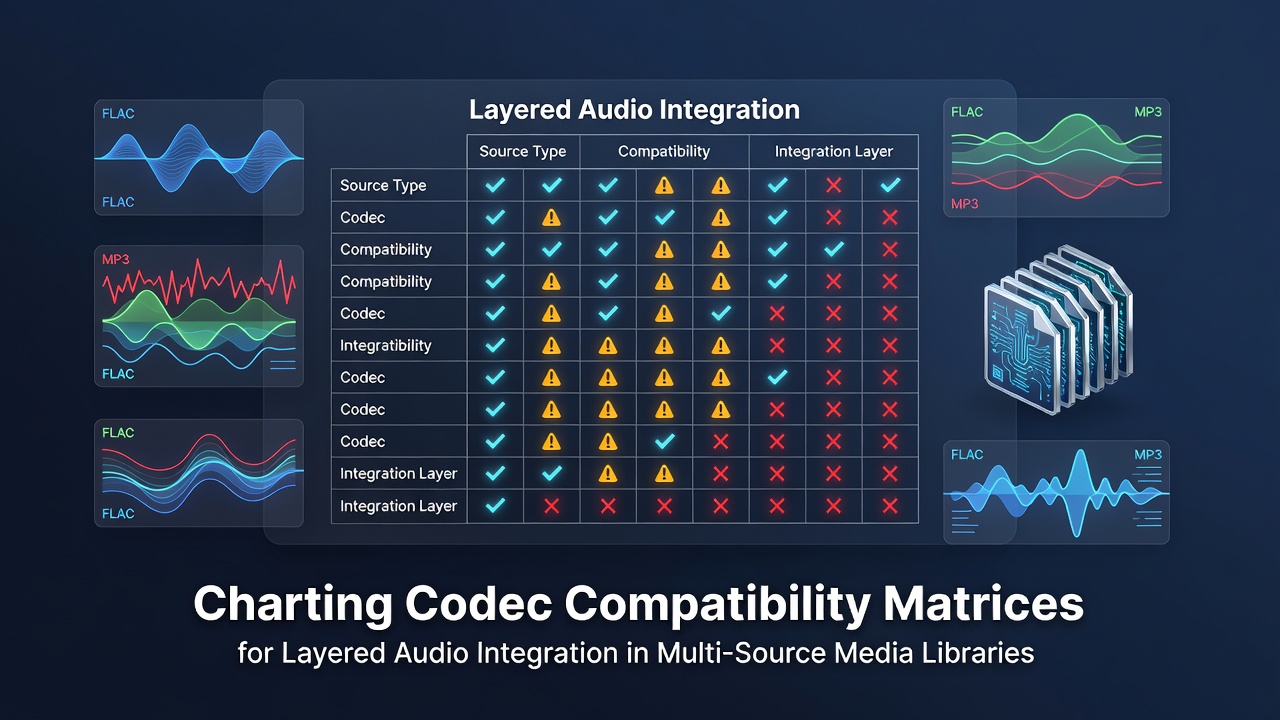
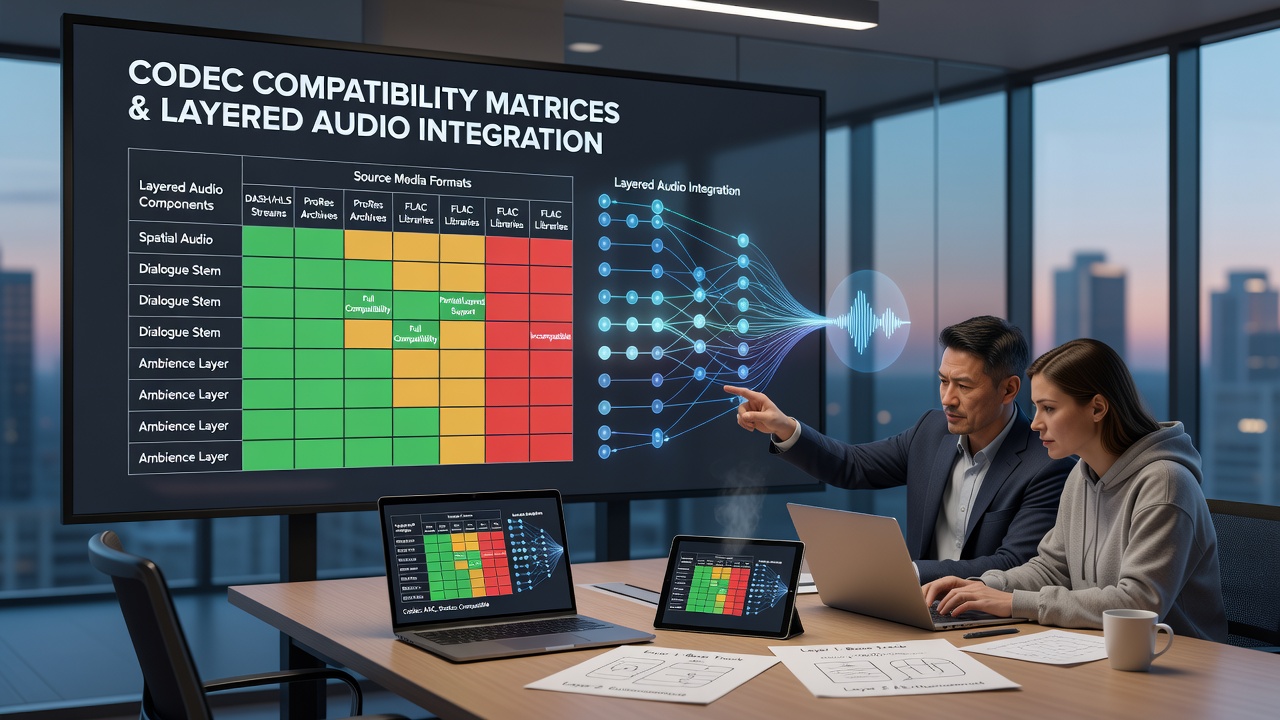
Media libraries that draw from streaming services, local archives, and peer-to-peer networks require systematic approaches to audio codec selection. Compatibility matrices map interactions between formats such as AAC, Opus, AC-3, DTS, and E-AC-3 when multiple layers combine in containers like MKV or MP4. Observers note that these matrices help identify conflicts in sample rates, channel configurations, and bit depths before integration begins. Researchers have documented how mismatched parameters produce playback errors or force transcoding overhead across different playback devices. Building a matrix starts with cataloging available codecs and their technical specifications. Engineers list supported channel counts, maximum bitrates, and container restrictions for each format. They then test pairwise combinations to record successful merges, forced downmixes, or outright failures. Data from standards organizations shows that Opus handles variable bitrates efficiently in low-latency scenarios while AC-3 maintains consistent performance in broadcast-derived files. Matrices therefore mark cells with green for native support, yellow for conditional compatibility, and red for required conversion.Layered Audio Integration Techniques
Layered integration allows simultaneous playback of primary dialogue, secondary commentary tracks, and isolated music stems within a single file. Tools such as FFmpeg apply filter graphs that align timestamps and normalize levels across layers. When sources originate from different libraries, one track may arrive at 48 kHz while another sits at 44.1 kHz; the matrix flags the need for resampling filters before muxing. Studies indicate that preemptive matrix consultation reduces post-merge artifacts by documenting acceptable conversion paths in advance.
Multi-source environments introduce additional variables. Files pulled from torrent networks sometimes carry non-standard channel layouts or proprietary extensions. Compatibility charts incorporate these outliers by testing against reference players and logging behavior under controlled conditions. In July 2026 several open-source utilities received updates that expanded matrix entries for newer spatial audio formats, reflecting ongoing shifts in consumer hardware capabilities.
Practical Matrix Construction and Validation
Teams populate matrices through automated scripts that iterate over codec pairs and record exit codes from encoding commands. Manual verification follows for edge cases involving high-channel counts or unusual bit depths. The resulting grid becomes a reference document shared across library maintenance workflows. One documented case involved a collection mixing European broadcast masters with North American streaming rips; the matrix revealed that DTS-HD MA tracks required extraction before AAC layers could be added without container bloat.
 External references provide baseline specifications that matrices build upon. The International Telecommunication Union publishes codec parameter guidelines used to populate initial rows, while reports from the Society of Motion Picture and Television Engineers supply container-level constraints that affect layer stacking. These sources help standardize entries across different geographic implementations of the same formats.
Challenges in Multi-Source Environments
Bandwidth variability across sources affects which codecs remain practical. High-bitrate lossless layers demand stable connections during initial ingestion, whereas lossy formats tolerate intermittent transfers better. Matrices therefore include columns for estimated file sizes and recommended delivery conditions. Observers note that libraries serving both mobile and desktop clients benefit from separate sub-matrices tuned to each platform's decoder support.
Version drift between library components creates ongoing maintenance tasks. When a new codec revision appears, teams retest affected cells and update color coding accordingly. Automated monitoring scripts flag files whose codec combinations fall outside current matrix guidelines, prompting review before they propagate through the collection. Research indicates that consistent matrix updates correlate with fewer user-reported playback interruptions in distributed archive settings.
Conclusion
Codec compatibility matrices serve as living documents that evolve with format standards and source diversity. They translate complex technical constraints into actionable grids that guide integration decisions across layered audio projects. Organizations that maintain these references report smoother workflows when combining material from multiple origins. Continued refinement of matrix entries supports reliable access to multi-source media libraries as codec ecosystems expand.